With luck,
your cat is going to live a long time with CKD, so it pays to learn how to
make medicating your cat as easy and stress-free as possible.
Many cats
dislike being restrained and pilled, so this page explains ways in which to
make the process go more smoothly for both of you.
There are
also links to veterinary drug reference information and how to check for
possible drug interactions.
For information on cutting amlodipine (Norvasc or Istin, used for
hypertension) into cat-sized doses, see
All
About Hypertension.
Cautions
Make sure you have been given the correct medication!
Mistakes can happen. If
you get your next round of supplies in before you have run out, you can
check to see if the pills look the same. If you have any concerns, check
with the pharmacist and your vet. You can also check some medications online (see
below).
Ask your vet before crushing a pill or mixing it with
liquid. Some medications are extended release, meaning that giving the pill
in crushed form releases all the medication in one go, which might be
dangerous with some medications. Other medications may be enteric-coated,
meaning they are intended to reach the small intestine intact. Crushing or
cutting such pills will stop this happening.
Never give a cat liquid medication from the front. You
should always syringe liquid medication from the side of the cat's mouth.
If you forget to give a pill, check with your vet, but
the general recommendation is to give it as soon as you remember, unless it
is nearly time for the next dose, in which case you should simply give the
next dose. So if you find your cat has spit up a daily morning pill six
hours after you gave it, you can give it again; but if you find the pill the
next day, just before you are due to give the next dose, do not double up
but simply give one dose.
Preparing Your Cat
I recommend
always telling your cat what you are doing and why, and how it will help
them feel better. It may sound strange, but some people have found that
their cats tolerate treatment better after they've had it all explained it to them.
You can also
choose a special word or phrase that tells your cat you are about to give
medication and/or fluids — your cat will soon learn what this means, and will
then not be stressed when you approach him/her at other times. It can also
be worth using treats after pilling so your cat does not associate pilling
only with bad things.
Methods of
Administration
There are four main methods of administration, though
oral medications are most commonly used:
If you only have to give one or two medications a day
that do not have a nasty taste, I would recommend
Pill Pockets. I gave my
two girls their amlodipine (for hypertension) in Pill Pockets for more than
three years. They both loved them, thought they were a treat and ate them
willingly (and even asked for more), which meant so much less stress for them
and me. I used the salmon flavour.
If you have to give several medications a day, or if you
have to give one that tastes unpleasant, I would consider
gelatine capsules. You can put several
medications in the capsule at once (exactly how many depends on the size of
the pills and the size of the capsule) so you only need to pill your cat
once, and your cat won't have to taste the nasty pill.
For
guidelines on using Epogen, Procrit, Eprex, NeoRecormon or Aranesp, and additional tips, see the
Erythropoiesis Stimulating Agents page.
For information on how to give Azodyl or Renadyl, click
here.
It is important to give oral medication correctly, because getting
it wrong may cause aspiration pneumonia, i.e. the medication goes down the
wrong way, into the windpipe and the lungs rather than to the stomach. This
is more common with liquid medications if they are given incorrectly, but
may occasionally occur when giving pills.
Never give a cat liquid medication from the front. You
should always syringe liquid medication from the side of the cat's mouth.
How
To Give Pills
The best way to give a pill is for your cat to freely
take it from you. There are products which can help with this, see
below.
If you do have to place the pill in your cat's mouth, the
goal is to get it on the back of your cat's tongue. Tilting the head
slightly can help. Hold the mouth shut for a few seconds while the cat
swallows it. Some people find blowing
gently on their cat's nose after placing the pill on the back of the tongue
encourages the cat to swallow.
You might
also want to try hiding the taste of your cat's pills, for example by
covering them with butter or Primula cheese, or mixing them in baby food.
Don't do this with bitter tasting medication such as famotidine (Pepcid)
though.
Never give a cat liquid medication from the front. You
should always syringe liquid medication from the side of the cat's mouth
into the cheek. This helps reduce the risk of
aspiration
pneumonia.
Recent
studies have shown that cats find it much easier to swallow pills if they
are given some water immediately afterwards.
It may also help to give a little water before giving a cat a pill.
Here are some
ways of using water chasers:
You can use
the sort of bottles used for feeding kittens.
You can
follow pills with some watered-down syringed food.
Alternatively you could give a little moist food, such as
a spoonful of
baby
food.
Some
pillshooters have built in
water reservoirs which enable you to give water immediately after pill.
Some people prefer to use injectable medications, finding this much less
stressful for both themselves and their cats. It also gets around the
problem of foul-tasting medicines. If you wish to do this, ask your vet to
teach you how to do this safely.
The downsides of injectable medications are that not many medications are
available in this form (you cannot inject oral medications, only medications
formulated specifically for injection), those that are available are usually
relatively expensive, and in most cases they only last for a month
Centers for Disease Control and Prevention
explains more about this).
Products to Help With Giving Pills: Pill Pockets
and Similar Products
I am not very good at pilling, so I try to use products
which are intended to make the process less stressful for all concerned. Possible products to use include Pill Pockets, Flavor Doh, Pill
Wraps, Goofurr or Lick-e-Lix.
Pill Pockets
Pill Pockets
are chicken, salmon or tuna and cheese flavoured treats
(45 to a pack) with a hidden pocket
in which to hide your cat's medication.
When both my cats were on medication for high blood
pressure, I found Pill Pockets a godsend. They both took their medication
happily, thinking it was a treat.
Unfortunately a CKD cat who doesn't feel well might not
eat Pill Pockets, and some cats do go off them, but if you don't use them
for bitter-tasting medications (such as famotidine (Pepcid)), you improve
your chances of ongoing acceptability. You can also give a few empty Pill
Pockets, with the odd one containing the medication (always end with an
empty one). My girls ate them happily every day for more than three years.
Although they didn't have CKD, Indie was even happy to eat hers when she
refused to eat normal food because of dental problems.
Some people find that, if they are only giving small
amounts of medication, they only need to use half of a Pill Pocket, which
means they last twice as long. I did this with my girls, since it can be
hard (though not impossible) to get Pill Pockets in the UK. One member of
Tanya's Support Group found that Pill Pockets
stay fresher longer if they are kept in the fridge.
I am occasionally asked if Pill Pockets are high in
phosphorus. Actually, they aren't, they have only around 0.64% phosphorus on
a dry matter analysis basis, but since you only give one or two a day, I
would not be too concerned if they had higher phosphorus levels.
Maropitant (Cerenia)
should not be given in Pill Pockets or mixed with food as this may stop
it being properly
absorbed in the cat's body, though some people do
give them this way, apparently with no problems.
USA
Pill Pockets USA
I used to buy Pill Pockets from Wholefoods.
One person found Pill Pockets at her local Costco pharmacy for US$4.95 a
packet.
A similar product but it comes in a tub and you use enough to wrap around the pill.
It is available from
Healthy Pets.
Pill Wraps
Pill Wraps
(sometimes known as Pillmasker)
are a similar product made by Vetoquinol. They are available from
a variety of sources, including
Entirely Pets and
Chewy.
Tomlyn Pill Masker
This is a bacon flavoured wrap product which some people have found helpful. It is available
from
Amazon.
Goofurr
Goofurr
is a
paste made from smoked salmon. Apparently most cats will
eat it willingly, but you can also smear it, complete with medication, onto
your cat's fur and the cat will lick it off. (Well, that's the theory. When
I gave Harpsie a similar product once, he carefully wiped his paw on my
cream sofa).
Shipping is quite expensive. Several members of Tanya's CKD Support Group have tried it
and found it effective.
Unfortunately Pill Pockets are not available in Europe,
and the manufacturers have no plans to introduce them into this market, but
there are ways to obtain them:
Amazon
UK sells Pill Pockets for £9.93
with free shipping. I have bought these myself, ordering on a Saturday, and
they arrived the following Wednesday. Unfortunately they are not always in
stock, however, if you wait a few days they usually reappear. If you are
desperate, they are also usually available from other sellers based in the
USA, but with very high shipping costs and they may take longer to arrive.
If they are not in stock at the free shipping price and you need them
urgently, it can be worth checking amazon.com too, because the sellers there
may charge you less overall.
Vitacost in
the USA sells Pill Pockets for US$6.49 per pack plus international shipping,
which is calculated by weight but which costs roughly USD6.99 for small,
lightweight orders and takes 7-14 days. Vitacost have local phone numbers in
UK, Australia and Hong Kong. I have not used Vitacost to ship to the UK, but
I used them within the USA and they were very efficient and very fast.
Other Pilling Products UK
Lick-e-Lix
Lick-e-Lix is a product with a yoghurty
texture
which can be used to disguise tablets, especially crushed up tablets. Some
people also find these helpful for encouraging their cats to eat.
One member of Tanya's Support Group asked the manufacturer about Lick-e-Lix
and was told the phosphorus level was around 1.1%.
If your cat is hard to
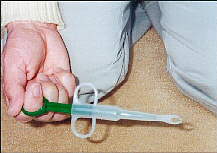
pill, it can sometimes help to use a pillshooter. Here is a picture of one
we purchased from our vet for £1.25. You can buy some pillshooters with
built in water reservoirs, so that you can follow the pill immediately with some water as
recommended above.
Pillcrushers can be helpful if you need to crush a
tablet before dividing it into cat-sized doses.
Amazon sells
one. Check with your vet before using one, because not every medication
should be crushed.
Gelatin Capsules
If you have to give your cat several medications, it can
be much easier to give them all at once by placing all the medications in an
empty gelatin capsule (sometimes referred to as gelcaps in the USA) and just giving the one capsule; this also gets round
the problem of foul-tasting medicines.
You buy empty
gelatin capsules and fill
them with the medications of your choice (though check with your vet about
the combinations you have in mind, since not all medications can be taken
with others).
It may help to coat the capsule in butter before giving it to
your cat: most cats like the taste of butter and it helps the gelcap go down
smoothly.
Gelatin capsules come in various sizes, from 000 - 5, with
size 5 being
the smallest.
As a general rule, you need the smaller sizes for cats, and
most people on
Tanya's CKD Support Group use size 3-4,
or occasionally sizes 2 or 5, depending upon how many
medications they will be putting in the capsule and how big their cat is.
If
you can only buy size 0 or size 1, one member found that if she took the
capsule apart and cut part off the top of one end, when it was reassembled
it was smaller and easier to give.
Torpac sizes shows actual sizes of capsules
from one manufacturer and gives some indication of how much you can fit in
each capsule size.
Filling gelatin capsules can be a bit fiddly so most people set up a little
production line and fill several at one time. After all, what else are
Sunday afternoons for? (Cake, if you ask me).
The easiest way to fill gelcaps is usually to buy a funnel. You can buy
funnels from some pharmacies or at Bed, Bath and Beyond (they are sometimes
used to decant perfume), but you need to be sure the funnel you buy will fit
your capsules.
Torpac sells little funnels
which fit their capsules. You have to specify which size capsules you are
using, but people have told me the funnels may also work for a size smaller
too e.g. a size 4 funnel may work for both size 4 and size 5 capsules.
Empty Caps Company sells a number of
capsule fillers starting at US$19.95 plus shipping. It also sells capsules in
various sizes.
Some people use otoscopes, available from Amazon
here
and
here.
Holding trays can be useful to hold the capsules while you are filling them.
Capsuline sells these in various sizes for
US$9.99. They are also available from
Amazon.
Other people fold a piece of paper or foil and pour the
contents into the capsules.
Gelatin Capsules: Where to Buy
It used to be difficult to find capsules but fortunately they are now widely
available, as follows:
Many health food shops or compounding pharmacies sell
empty gelcaps. Health food shops usually sell the
NOW brand in a size 3.
If they don't have them in stock, they can usually order them for you quite
quickly.
Sell a
variety of gelcaps from size 0 - size 5, with prices between US$3 and US$9 for
100. If you enter
the word "tanya" (without the ") in the
promotional code box, you will receive a 10% discount on orders over
US$100. Shipping is free for orders over US$49 (after the discount).
sell 100 size 4 capsules for £1.07 and 500 for
£5.35. I don't know anybody who has used this company yet. Their English
is not that of a native speaker, though they are supposedly based in
Corby.
Some of the US sellers above, such as Capsule Supplies, will ship to the UK, though shipping costs are
likely to be high.
Sell a
variety of gelcaps from size 0 - size 5, with prices between US$3 and US$9 for
100. If you enter
the word "tanya" (without the ") in the
promotional code box, you will receive a 10% discount on orders over
US$100. Shipping is free for orders over US$49 (after the discount).
Sells size 3 chicken flavoured Cat Caps for US$26.20 per 1000
plus shipping.
Will ship to Canada.
Compounded Medications
In the USA
and some other countries, it is possible to have medications compounded into
a base of your choosing. These can be in either pill,
liquid or capsule form.
Common
flavours popular with cats are fish, chicken etc. Not all cats like the
taste of compounded medications, and they are relatively expensive, but they
are worth considering for hard-to-pill cats. Compounding is essential for
calcitriol —
it is the only way to obtain cat-sized doses, and it seems to work very well
in compounded form.
See
below for
information on finding a compounding pharmacy.
Compounded medications have a short shelf life, a maximum
of thirty days for many medications, so check with the pharmacist and be sure not to use a product beyond
its expiry date. If the product you are purchasing has a longer shelf life,
it is often not much more expensive to buy 60 days worth of medication than
it is to buy 30 days.
Do double
check with your pharmacist regarding the medication you are considering
having compounded, and consider switching to pills if the compounded form
does not seem to be working as well as you expected. If
you use a liquid compounded medicine, be sure to shake it very well before
giving it to your cat.
Confounding compounding
is a 2009 report from the Veterinary Information Network on the pros and cons of compounded medications.
You can type in your zipcode and how far you are prepared to travel and you
will be given details of suitable pharmacies. This site also provides
details of compounding pharmacies in Spain, Portugal, Canada, Chile, Brazil
and Australia.
In the UK, compounding (known as "unlicensed specials")
is not very common and often very expensive.
This is because UK law requires veterinary surgeons to
comply with something known as the veterinary cascade, whereby vets must
prescribe medicines in a particular order, starting first with medications
approved specifically for the veterinary market and only moving on to other
products if there is a valid medical reason for doing so (e.g. the cat is
allergic to something in the licensed veterinary product).
The British Small Animal Veterinary Association
explains more about how it works.
Beva
explains how the cascade works and how specials fit into it.
With some
medications, it is possible to have them compounded into a transdermal
gel, which is rubbed on the inside of the cat's ear and absorbed through the cat's skin.
This is usually much less stressful for both the cat and the caregiver.
Advances in transdermal drug delivery
(2013) Mills P
Presentation to the 38th World Small Animal Veterinary Association World
Congress discusses the mechanism of transdermal
medications and factors which affect their efficacy.
Drug compounding for veterinary patients
(2005) Papich MG American Association of Pharmaceutical Scientists
Journal07(02) ppE281-E287 discusses the use of compounded
medications, including transdermals, and states that evidence to date
suggests that "absorption was incomplete, nonexistent, or highly
inconsistent among cats."
Trandermal Medications: Suitable Medications
Medications
that appear to be effective when given transdermally include
methimazole
for hyperthyroidism and
mirtazapine (an appetite stimulant).
If you do use transdermal medications,
you should apply them using gloves so as to avoid absorbing any of the
medication through your own skin.
The Veterinary Information Network
has some information on this. You should also clean your cat's ears
regularly so the medication can be absorbed properly.
Hyperthyroid cats and transdermal methimazole
is a helpful video which explains more about how to use transdermal
medications in cats with hyperthyroidism. It includes tips on cleaning your
cat's ears.
Not Suitable Medications
It is wiser
not to give certain medications transdermally because they do not all give good and/or consistent results.
This applies in particular to:
antibiotics
heart medications
blood pressure
medications
Some members of Tanya's CKD Support Group have found
for example that transdermal amlodipine
has not successfully controlled their cat's blood pressure, whereas
amlodipine tablets have done so.
Also, some cats may develop sore ears where the compounded medications are
applied; alternating ears may help with this.
Do double
check with your pharmacist and consider switching to pills if the
transdermal form of the medication does not seem to be working as well as
you expected.
Pillcutters
Since cats often require low dosages of medication, you
often have to cut tablets in order to give them the correct dose. This is
particularly hard with ranitidine, where you often have to cut the tablets into
eighths.
Invest in a
pillcutter (Betterware sell them for about £4, or you can often find them in
chemists), and apply hard, fast taps when you cut the tablet — don't try to
cut it slowly or the pill will crumble.
Walgreens sells the Apex brand for US$3.979.
I have two of these and really like this model — it cuts well, and has a useful
little container to hold the pills after you've cut them.
For information
on cutting amlodipine (Norvasc or Istin, used for hypertension) into
cat-sized doses, see Hypertension.
Timings
It can be fiddly working out suitable timings for your cat's medications, particularly
if you work outside the home and are using medications that need to be given
apart from other medications. It does not help that some medications need to
be given with food and some away from food.
Pill Pockets or gelatin capsules
can help for meds that can be given together. With gelatin capsules, you can
package your cat's medications in advance (see
above).
Here is a sample timing schedule based on commonly used medications (not all
of these will be needed for your cat). It
should be noted that slippery elm bark and phosphorus binders ideally should
be given apart from other medications, but phosphorus binders should be
given with food. Check your other medications against a drug interaction
website (see below), and double check with your vet or pharmacist.
07.30 a.m. In a gelatin capsule: famotidine, B
complex, mirtazapine, MiraLAX, pain medications, antibiotics
08.30 a.m. Breakfast mixed with methylcobalamin and phosphorus
binder if required
Daytime Food with added phosphorus binder
06.30 p.m. In a gelatin capsule: B complex,
mirtazapine, pain medications, antibiotics
07:30 p.m. Dinner mixed with methylcobalamin and phosphorus
binder if required
11.00 p.m. Famotidine
Medisafe
is an app that can be used to log and remind you about when medication is
due.
Metric
and American Measurements
It can be confusing when you are trying to measure medications because
Americans are used to thinking in pounds and ounces but the veterinary
recommendations are often in kg and g and mg. It may help to know that:
a kg is 2.2 lbs.
A pound is a little under 500g.
100g is
roughly 3.5 ounces.
teaspoons vary in size, but a teaspoonful
is usually considered to be the equivalent of 5ml. If you are given
medication in the UK with a teaspoon included, it will hold 5ml or 5g.
one advantage of the metric system is that measurements are uniform, so
for example (if you are measuring volume) 1cc is the same as 1 ml.
If you need
to measure small amounts,
Amazon sells Norpro measuring spoon for a
pinch, smidgen etc. A member of my support group
measured these spoons and said that the spoons measured as follows:
Spoon Size
Holds (tsp)
Tad
1/4
Dash
1/8
Pinch
1/16
Smidgen
1/32
Drop
1/64
Amazon also sells an "odd sizes" set of measuring spoons
which includes two thirds of a teaspoon and an eighth of a teaspoon.
Drug Reference Guides
Commonly Used Medications
VetBook has a
list of medications commonly used in cats with details of typical dosing.
Pet
Placehas a drug library which offers information on 105 different
drugs.
PetCoach also has a drug library with
information on various medications.
Dosage Adjustments in CKD Cats
Drug
dose adjustments for disease
(2010) Trepanier LA CVC in Washington Proceedings discusses
the need to adjust dosing levels for some medications when diseases
including CKD are present.
Mar Vista Vet has helpful information on various drugs, including how
they work and possible interactions and side-effects.
Express Scripts allows you to type in the
names of medications and check for interactions. It also allows you to see
photos of a medication in various strengths. The information is human-based
but can be a helpful starting point.
This is an excellent reference book. The Ninth Edition was published in
February 2018. It is available from
Amazon in the USA and from
Amazon UK.
Medical
Abbreviations
The most
commonly seen abbreviations on medications are:
SID (semel in
die): once a day
BID: twice a
day
TID: three
times a day
PRN: as
needed. This can be helpful on prescriptions because it can enable you to
order more of an item when you run out without needing to obtain a new
prescription (though prescriptions are normally only valid for a maximum of
one year).
Links on this page last checked:
07 September 2020
*****
TREATING YOUR CAT WITHOUT VETERINARY ADVICE CAN BE
EXTREMELY DANGEROUS.
I have
tried very hard to ensure that the information provided in this website is
accurate, but I am NOT a vet, just an ordinary person who has lived
through CKD with three cats. This website is for educational purposes
only, and is not intended to be used to diagnose or treat any cat. Before
trying any of the treatments described herein, you MUST consult a
qualified veterinarian and obtain professional advice on the correct
regimen for your cat and his or her particular requirements; and you
should only use any treatments described here with the full knowledge and
approval of your vet. No responsibility can be accepted.
If your cat
appears to be in pain or distress, do not waste time on the internet,
contact your vet immediately.
This site was
created using Microsoft software, and therefore it is best viewed in
Internet Explorer. I know it doesn't always display too well in other
browsers, but I'm not an IT expert so I'm afraid I don't know how to
change that. I would love it to display perfectly everywhere, but my focus
is on making the information available. When I get time, I'll try to
improve how it displays in other browsers.
This site is a labour of love, from which I do not make
a penny. Please do not steal from me by taking credit for my work.
If you wish to
link to this site, please feel free to do so. Please make it clear that
this is a link and not your own work. I would appreciate being informed of
your link.


 If your cat is hard to
pill, it can sometimes help to use a pillshooter. Here is a picture of one
we purchased from our vet for £1.25. You can buy some pillshooters with
built in water reservoirs, so that you can follow the pill immediately with some water as
recommended
If your cat is hard to
pill, it can sometimes help to use a pillshooter. Here is a picture of one
we purchased from our vet for £1.25. You can buy some pillshooters with
built in water reservoirs, so that you can follow the pill immediately with some water as
recommended 